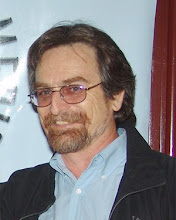
So this essay is one that I want to make into a film - preferably a documentary with dramatic overtones. I have no idea how to turn this completely internalised event into an externalised and even-remotely-artistic event, but I am working on it... sort of Chien Andalou crossed with My Dinner With Andre, perhaps. Ok, that was a joke, but this blog ain't.
* * *
On a day like any other – it could have been any day – a minor complaint prompts a question. An inquiry. An examination. . . and suddenly nothing is the same. The things which were big things become small, and all that had been small things disappear. You feel the curtain falling, you see clearly the weakness of living, in an instant you recognise the fragile skin of life. Closing, the eyes truly open – and the turning world continues.
Life holds a moment when the silence drowns out everyday sounds and a man’s fears are suddenly terrifying. For me, that moment came in a small examination room, while a white-coated doctor described a Texas-sized tumor inside my chest.
With the sweat came the realisation that it’s in there, and you can’t get it out. But now the man’s talking numbers: survival rates, percentages, things only measured long after the deal is done, when you’re either laughing in Aruba or rotting in Pleasant Acres.
The patient faces the doctor – recently met, now with the egregious duty of informing this stranger that his life may be over – and stutters out a request to repeat the words. The wife cries quietly, seeing the future more clearly than her husband. Soon, with any luck, this man will know all about patient, as doctors prod and lead and jerk him around in a display of human frailty that is remarkably life-like. But now he’s too stunned to notice her silent tears, and she is too consumed with a single idea: he must somehow survive.
* * *
My mental list of what it takes to be a man: A man doesn’t cry, is always prepared, doesn’t complain and bears his pain quietly. A man protects himself and those around him. He won’t exploit, depend, or take his friends for granted. I’d taken at least one side and had held it all my life. I owned and would not lose the strength of conviction; I was strong and could fight if I had to. And it became clear that I had to fight – fight the cancer, fight to stay alive. Of course, I was to also learn some distinctly different lessons in the months to come.
* * *
A delightful irony: at forty-five, I was stricken by a young-people’s disease. Most Hodgkin’s patients are 18 to 24. And Hodgkin’s is neat, clean and imminently curable – I was puzzled when they called it the ‘good’ cancer.
The tumor was pressing on both my heart and my lungs, causing me to have poor circulation and extreme shortness of breath. Again, the ironies: as an educated man, I could not help but recognise that the tumor struck at the center of our collective notion of courage (from the Latin for ‘heart’). Moreover, the tumor attacked my lungs, where I breathe (spirit comes from the Latin for ‘breath’). How often in life do we hear these words matched up with our notion of manhood: “That fighter’s got a lot of heart;” “He has the spirit to win this one.” With these two areas so compromised, how was I to defend myself against this threat to my life?
And the effects of cancer weren’t merely philosophical. I was physically weak, I couldn’t work for more than a few minutes at a time, and could not sleep. I had lost twenty pounds to land at a feeble 160 and was tired all the time. The tumor was consuming almost everything I ate, leaving the rest of my body to starve. My life had turned around, and I wasn’t liking the direction it took.
My wife drove me to the infusion center for chemotherapy every two weeks, because the treatment wiped me out too much to walk, much less to drive. Working from graphs which told the maximum I could take without dying, brisk professionals put poisons into my veins as I watched – and waited – for the effects. At the infusion center, they gave me palliative drugs for nausea and other side effects, but I hated taking them. I quickly reduced my intake of these additives to a minimum, resigned to pull in my ears and bear the physical discomfort.
We attended, respectively, a “survivors’ group” and a “caretakers’ group” - learning new things about chronic and catastrophic disease in America today... and about the politics of disease.
* * *
It’s a hard thing to wake each day into the sickness again, without relief, to see yourself in the mirror more debilitated and feeble each time – the constant reminder of failing health, to know that you are not what you were, that in fact you are so much less than you were, that you are constricting, shrinking each day in your movement, in your strength, in your already-severely-limited abilities. And added to that are the difficulties of relentless treatment. If the sickness is pernicious, the treatment itself is vicious.
You must make all those minor and major adjustments, you must acquiesce and compromise, you must accept that your life probably will never be as it was. You can accept it with grace or you can fight it. But this is the real deal, pal: you can’t stay the same.
And of course, that’s what life is all about, at the end of the day. Forget the illusion of a continuing arc of achievement until we die in the lap of luxury. For most of us, that will never happen – our present success won’t help at the end. The smaller office, the less-luxury car, downsizing, painful joints, the ex-wife, the hated retirement, estranged kids, move to a furnished room, calendar filled with medical appointments, assisted living, the catheter or colostomy: a series of minor adjustments, compromises, large and small acquiescences, rationalizations. We can only hope that we won’t find ourselves on the downward slope of the hill without ever having enjoyed the summit. We will age until we become too weak to feed and care for ourselves, and we’ll hang on until one day we just . . . die.
* * *
As I watched people disappear from my survivors’ group, I began to feel like Barabbas, delivered from mine enemies – but at what cost? Some other cancer patient filled the statistical spot that might have been meant for me under the title: “Annual Deaths from Cancer.” The analogy of Barabbas haunted me – the thief chosen by his people to be free, the committor of seemingly ‘small’ crimes, yet whose sins are greater than those of he whom was punished. The shrink at the infusion center had asked me whether I thought that cancer was a punishment (it turned out that, given the Judeo-Christian ethic, many people do). I looked at him as though he had asked me whether winning at the track were the Reward to the Faithful, and said, “Of course not – it’s just the luck of the draw.”
But my insomniac mind spun with these ideas, having little else to think about but my failing health and my business, which had faltered as a result of my absences. There was no religious significance attached to the idea of Barabbas and redemption, hardly any moral to be learned and little philosophy – only the irony of one man’s trial being greater than another’s, and that being the guy with the light end of the load seemed sometimes hard to take.
Of course, the light end of this particular load was still heavy indeed. I would live on, bearing the complications and having opportunities to change aspects of my life, trying to become happy at last. Is that how Barabbas reacted? Did he walk down that long hill in the light rain amid sunny patches, renouncing his thieving ways and resolving to live a truly happy life for a change, after a long-deserved vacation over in Hebron?
* * *
Interesting phenomena began to occur when the chemo really started to stack up in my body. The nature of most chemotherapies is that they are progressive and cumulative – the further down the line you go with them, the more they remain in your body and therefore the more they’ll affect you. I was getting my ass kicked with some true sincerity from the third through the eighth day – five or six full days of rat poison flowing through my system, twisting every human response into something quite unpleasant and scary, most accurately described as having a corpse shoved into your skin along with you.
I watched the slow progression, as the man who lived in the mirror lost his thick head of hair, then his beard. And then one day his mustache fell off. His features became harder and more severe, and I was reminded of a description of an old cavalry officer by George MacDonald Fraser: “He was a tough old file with a flinty gaze.” And that was who looked back at me from the mirror – a tough old file, one I couldn’t recognise.
So here I was, in the middle of my fifth cycle (having received chemo nine times) and the effects were just pounding me into the ground. I’m told that it’s something like a woman’s period . . . and so much more. I don't know if the effect can be blamed on hormones, but the wash of emotions I experienced was frankly stunning. Profound feelings of hopelessness, despair, fear, weakness, dependence, cowardice – all the things which my life had supposedly girded me against – would overwhelm me at odd moments and set me spinning to a snappy little dance number played by Death’s soloist himself.
There were times that I could hear my Uncle Ironhand’s voice floating through the long tunnel from my childhood, repeating a joke he liked: “I tell you: first I was afraid I would die. Then I was afraid I wouldn’t!” I’d find myself longing for death as a way out of the pain, then I’d chide myself for such silly thoughts. There was logic lost there – I was, after all, undergoing this pain to avoid death. But the mind does funny things. On certain days, in certain hours, it all just seemed too big to cope with. I was reduced to the outlook of a little boy – a scared and vulnerable little boy, stripped of the years of training in becoming a man, in hardening himself to the difficulties of life. I was a little boy who felt no shame in crying.
And in those moments, somehow, I learned what strength is – not what we believe it to be, or what big-screen heroes show us, nor what we want it to be or need it to be – what it actually is. Strength is forever allied with faith: the faith that we can get through, if we can just hang on. The child can believe, and persevere, perhaps because he has not had all that training in becoming a man.
And then the realizations start to come. A clarity takes over which peels away all the happy horseshit and the clichéd beliefs we spoon-feed ourselves every day. A man can look at the bare face of life and learn his lesson, without fanfare – and, if he’s lucky, without regret.
To really accept being the essence of a man relates back to several archetypes, one of them the failing father, the man looked down upon by the son for not being as good as the son has become. But how could he be? How could the father – over and over throughout time – consistently be better than the son? First, nobody would like the effects of that. Objections would be raised. And more important, it defies evolution. Each generation must improve, if a species is to survive. Sons must become more – and better – than fathers.
And we can’t forget the partner and the mentor, both archetypes with very necessary social functions. There is more to mating than the act of procreation. The joining of two lives involves a variety of small relationships stacked into a larger, more penetrant and encompassing relationship with the same person – the partner. And the mentor is a friend and teacher, one who guides the younger person into and through the confusing labyrinth of social and natural relationships. These facets of adulthood – and, by extension, of manhood – are secondary to the relationship with self, but they are crucial for an individual’s healthy functioning.
There is also the laudable trait of just being there, a solid post in the community to lend a hand when needed, or perhaps to merely be a witness – the good neighbor, another often-overlooked archetype.
The truth is that we don’t need as many heroes as we need men to admire them. And why do we admire heroes? Because we’re ordinary. As special as each of us might be, compared to heroes we are only ordinary. So be it. The descent into ordinariness is another facet of strength.
Yes, we admire heroes because we’re ordinary. The true strength is this: We go through our lives, learning our lessons and taking our knocks, often never realising that this is all there is. No redemption, no third act, no flashing moment of enlightenment: just more of the same. Just our own ordinariness, the diminishing strength, our incipient weakness, until we fade or fall away.
And that’s being a man. That’s where a man’s true strength – his real beauty – is found: To keep pushing forward, knowing that there are no more big kills, no awards or golden moments, no endless summers. To accept that, and to stay focused on just reaching the goal when all the glory is behind you, to keep showing up, suited up, long after you haven’t got a double-play left in you – that’s the strength of a man.
Nothing flies for long without coming to ground, and to glide gently in with grace and élan makes a much better story than to crash and burn, a million biker tattoos notwithstanding.
David Hakim is an assistant director, producer, and publicity expert who developed campaigns for every major Hollywood studio and handled publicity for the Motion Picture Academy. Find him in the Reel Directory online: www.reeldirectory.com.
All material copyright 2008 David Hakim and may not be duplicated - ALL RIGHTS RESERVED.
Mostrando las entradas con la etiqueta documentary. Mostrar todas las entradas
Mostrando las entradas con la etiqueta documentary. Mostrar todas las entradas
jueves, 21 de mayo de 2009

sábado, 28 de marzo de 2009
Crazy Plots to Save the World
Many forward thinkers have agreed that the challenges of the next half-century will be great ones, and they will likely center on a couple of critical areas. Of course, food is always an issue for the greater fraction of people on the planet, but clean unpolluted water is about to become a very problematic – and expensive – issue as well. A third area about which I have heard little from the scientific community is ‘staying warm’ – and since one of the basic necessities of life is ‘staying warm and dry,’ I am concerned that not enough brain-power is being put into keeping people warm without further warming the planet.
Long ago, I wanted to get people interested in bringing troubling societal issues to the members of Mensa, the high-IQ society. I thought – and still think – that those eggheads could help us find elegant solutions to some of our toughest problems. I mean, they have all that knowledge, right? Problem was, the men and women of Mensa didn’t seem to want to tackle hard problems like feeding the hungry, housing the homeless, or saving the planet. Like tired and lonely people everywhere, they were more interested in connecting with other smart people socially, as in dating or in special interest groups (which they called SIGs).
So I wandered away from Mensa, leaving them to their puzzlers and parties. But I still think about trying to save the planet, save our culture, save our way of life, save the lives of those unfortunate enough to need our help. To do any of those things, we need some innovative thinking – we need to approach the same old problem in a brand-new way. And a collection of brilliant minds is a crucial prerequisite to removing the obstacles to the creative development of innovative thinking. And, of course, I can’t do it all alone. So I turn to you, the filmmakers on the cutting edge, to be part of that collection of minds – since filmmakers always have been (and continue to be) innovators, inventors, and visionaries.
And maybe just focusing a camera on a problem is a good start at getting people to think about that problem. We can't fix what we haven’t identified, and we can’t identify what we don’t know about. So for some of us, at least, there is just the work of pointing the issues out to others, so that they can learn about those situations that can harm us or those like us. Also, people want to know that there is hope, and documentaries serve that function, among many others.
Docs can inform, educate, and persuade. They can mean the difference between a deep understanding and the indifference of ignorance. Perhaps most important, documentaries can inspire. So here are some thoughts for documentaries, in case any of you filmmaking geniuses have run out of challenging and engaging ideas:
1. Innovative thinking about Energy Conservation: Why do we have every one of those city lights on all night long? Civic lighting expends more than half of the energy used in the US, and we could get buy with a lot fewer lights. I’m not talking about making the streets dark and unsafe, but we could install switches on about half the lights in any string, and alternate them all night long – or at least in the wee hours of the morning when most people are in bed.
2. Innovative thinking about Intended-waste Products: Why do we have bright white paper napkins, cups, bowls, and plates? The bleaching of paper accounts for a huge percentage of toxic waste going into rivers and our oceans, and we really don’t need bright white items that we are going to use once and then throw away. What are the biases against grey or tan disposable napery and plates? And those awful disposable diapers (though the rumor is that disposables are actually more planet-friendly than washing cloth diapers) – why are they white? For that matter, why is toilet paper white?
3. Innovative thinking about the Ramifications of Oil Drilling: How about getting groups of university students in different disciplines to deal with the deleterious effects of oil drilling – both to the land and to the very fragile ecosystems of the oceans. Big Oil drills for oil in the middle of farmland, if that’s where the oil is – and oil drilling is a dirty business. They (and we) hardly consider the effect of the runoff into the water table and into the soil in which farmers grow our food. How is all that oil affecting our health? And how can it be stopped? And while we’re talking oil fields, how can we stop those flares of flame that burn continually in the fields? It’s called the burn-off
4. Innovative thinking about Staying Warm and Dry: It seems that everyone is talking about global warming, but a much greater problem is how to keep people warm – heating is probably the major issue confronting us in the 21st Century. This is perhaps the most profound need of the entire human race, no matter where they live (even hot climates get cold sometimes). The whole of history has included the continual attempt to mitigate weather, creating warm and dry conditions in which to thrive. For atmospheric reasons, several long-time answers must now be discarded: wood fires, coal, and oil. Natural gas is much cleaner, but it will last only so long. Going underground, though costly and unattractive to most folks, that may be the answer – issues to be addressed include heating, leakage of surface water, disposal of waste, recycling air and gas byproducts, lack of windows and light, mass-transit elevators and logistics of moving people to the surface and back.
5. More innovative thinking about Staying Warm: Deep-strata mines may provide a solution, since the earth’s crust gets hotter by one degree for every thousand feet that you descend – by opening up large enough vents, we may be able to use the earth’s heat to replace much of the surface burning that we are doing.
6. Innovative thinking about Water and Water Rights: Water shortages and pollution will be major themes in the coming decades. Who is working on the potential of using seawater for most uses? And are there projects for reclaiming seawater (desalinization)? What new products are on the horizon to shift consumer water usage? And who owns the water anyway? That’s a question to which most of us won’t like the answer.
So there you have it – some ideas about coming up with ideas. A list of things that need addressing, and perhaps we can point a camera at them and thus put them in front of an audience or two. If you can do something with these ideas (and have the wit and strength to chase them with camera), you have my blessings.
David Hakim is an assistant director, producer, and publicity expert who developed campaigns for every major Hollywood studio and handled publicity for the Motion Picture Academy. Find him in the Reel Directory online: www.reeldirectory.com.
All material copyright 2008 David Hakim and may not be duplicated - ALL RIGHTS RESERVED.
Long ago, I wanted to get people interested in bringing troubling societal issues to the members of Mensa, the high-IQ society. I thought – and still think – that those eggheads could help us find elegant solutions to some of our toughest problems. I mean, they have all that knowledge, right? Problem was, the men and women of Mensa didn’t seem to want to tackle hard problems like feeding the hungry, housing the homeless, or saving the planet. Like tired and lonely people everywhere, they were more interested in connecting with other smart people socially, as in dating or in special interest groups (which they called SIGs).
So I wandered away from Mensa, leaving them to their puzzlers and parties. But I still think about trying to save the planet, save our culture, save our way of life, save the lives of those unfortunate enough to need our help. To do any of those things, we need some innovative thinking – we need to approach the same old problem in a brand-new way. And a collection of brilliant minds is a crucial prerequisite to removing the obstacles to the creative development of innovative thinking. And, of course, I can’t do it all alone. So I turn to you, the filmmakers on the cutting edge, to be part of that collection of minds – since filmmakers always have been (and continue to be) innovators, inventors, and visionaries.
And maybe just focusing a camera on a problem is a good start at getting people to think about that problem. We can't fix what we haven’t identified, and we can’t identify what we don’t know about. So for some of us, at least, there is just the work of pointing the issues out to others, so that they can learn about those situations that can harm us or those like us. Also, people want to know that there is hope, and documentaries serve that function, among many others.
Docs can inform, educate, and persuade. They can mean the difference between a deep understanding and the indifference of ignorance. Perhaps most important, documentaries can inspire. So here are some thoughts for documentaries, in case any of you filmmaking geniuses have run out of challenging and engaging ideas:
1. Innovative thinking about Energy Conservation: Why do we have every one of those city lights on all night long? Civic lighting expends more than half of the energy used in the US, and we could get buy with a lot fewer lights. I’m not talking about making the streets dark and unsafe, but we could install switches on about half the lights in any string, and alternate them all night long – or at least in the wee hours of the morning when most people are in bed.
2. Innovative thinking about Intended-waste Products: Why do we have bright white paper napkins, cups, bowls, and plates? The bleaching of paper accounts for a huge percentage of toxic waste going into rivers and our oceans, and we really don’t need bright white items that we are going to use once and then throw away. What are the biases against grey or tan disposable napery and plates? And those awful disposable diapers (though the rumor is that disposables are actually more planet-friendly than washing cloth diapers) – why are they white? For that matter, why is toilet paper white?
3. Innovative thinking about the Ramifications of Oil Drilling: How about getting groups of university students in different disciplines to deal with the deleterious effects of oil drilling – both to the land and to the very fragile ecosystems of the oceans. Big Oil drills for oil in the middle of farmland, if that’s where the oil is – and oil drilling is a dirty business. They (and we) hardly consider the effect of the runoff into the water table and into the soil in which farmers grow our food. How is all that oil affecting our health? And how can it be stopped? And while we’re talking oil fields, how can we stop those flares of flame that burn continually in the fields? It’s called the burn-off
4. Innovative thinking about Staying Warm and Dry: It seems that everyone is talking about global warming, but a much greater problem is how to keep people warm – heating is probably the major issue confronting us in the 21st Century. This is perhaps the most profound need of the entire human race, no matter where they live (even hot climates get cold sometimes). The whole of history has included the continual attempt to mitigate weather, creating warm and dry conditions in which to thrive. For atmospheric reasons, several long-time answers must now be discarded: wood fires, coal, and oil. Natural gas is much cleaner, but it will last only so long. Going underground, though costly and unattractive to most folks, that may be the answer – issues to be addressed include heating, leakage of surface water, disposal of waste, recycling air and gas byproducts, lack of windows and light, mass-transit elevators and logistics of moving people to the surface and back.
5. More innovative thinking about Staying Warm: Deep-strata mines may provide a solution, since the earth’s crust gets hotter by one degree for every thousand feet that you descend – by opening up large enough vents, we may be able to use the earth’s heat to replace much of the surface burning that we are doing.
6. Innovative thinking about Water and Water Rights: Water shortages and pollution will be major themes in the coming decades. Who is working on the potential of using seawater for most uses? And are there projects for reclaiming seawater (desalinization)? What new products are on the horizon to shift consumer water usage? And who owns the water anyway? That’s a question to which most of us won’t like the answer.
So there you have it – some ideas about coming up with ideas. A list of things that need addressing, and perhaps we can point a camera at them and thus put them in front of an audience or two. If you can do something with these ideas (and have the wit and strength to chase them with camera), you have my blessings.
David Hakim is an assistant director, producer, and publicity expert who developed campaigns for every major Hollywood studio and handled publicity for the Motion Picture Academy. Find him in the Reel Directory online: www.reeldirectory.com.
All material copyright 2008 David Hakim and may not be duplicated - ALL RIGHTS RESERVED.
Uncomfortable Documentaries & Narrative
“But in these plethoric times – when there is too much coarse ‘stuff’ for everybody and the struggle for life takes the form of competitive advertisement and the effort to fill your neighbor's eye, when there is no urgent demand either for personal courage, sound nerves or stark beauty – we find ourselves by accident.
“Always before these times, the bulk of the people did not overeat themselves because they couldn't, whether they wanted to or not, and all but a very few were kept ‘fit’ by unavoidable exercise and personal danger.
“Now, if only he pitch his standard low enough and keep himself free from pride, almost anyone can achieve a sort of excess. You can go through contemporary life fudging and evading, indulging and slacking, never really hungry nor frightened nor passionately stirred, your highest moment a mere sentimental orgasm, and your first real contact with primary and elemental necessities the sweat of your deathbed.” – H G Wells
~ ~ ~
One of the uncomfortable things about documentaries (and perhaps one major reason that certain docs are not popular) is that they present us with challenges – moral and ethical challenges, challenges to what we have ‘learned’ and to our thinking.
It is easy for the uninformed to come to an opinion – all one must do is to look at a situation and decide that it is right or wrong, entirely based on one’s preconceived notions.
But a thoughtful and well-researched documentary on a tough subject removes our ability to evade and fudge. Seeing the evidence of our thoughtless collective actions (global warming, over-consumption, wasteful uses of natural resources) puts the viewer in an uncomfortable spot, and it is a discomfort that the doc usually can’t hope to alleviate.
This is one excellent reason to include such challenging examinations into our narratives. The inclusion can be very subtle, such as one used in The Brave One, directed by Neil Jordan. The film’s protagonist (played by Jody Foster) was originally a police-beat reporter. But Foster, a self-admitted ‘NPR fanatic,’ thought that making the protagonist an NPR personality who studied New York City through its sounds.
This change served, as it turns out, a number of purposes. First, it made the protagonist much more internal and isolated from connection with people, while at the same time giving her a unique view of the world around her. Second, it solved a script problem that possibly had not come up until the change – any crime-beat reporter would have had much more knowledge of police procedure than Foster’s character had, so her naiveté would make much more sense if she had another, less-informed career. And third, NPR got some minor billing, which means that perhaps some of the audience dialed in for the first time and found something that cannot be found on standard radio.
The Brave One, while not a masterpiece, is still a solid piece of filmmaking, as might be expected from Mr Jordan. And while that single alteration in the story and script did not change the theme of the film, it did create profound changes in the film’s plot, sound design, production design, sets, and characterization.
In the case of those tough documentary subjects mentioned at the top of this piece, the narrative may come to a slightly different turn, but one no less personal in its application. Any of the tough subjects can be placed a bit in the background (what we call in journalism ‘burying the lead’) by starting the story with the person or persons most affected by the event or situation –say, the Hindi farmer facing starvation because of major climate shifts, or the havoc wreaked for local residents by land abuses such as strip-mining or deforestation. Alternately, the narrative of a documentary about over-consumption could start with the ‘birth’ of a consumer product that then goes through its ‘life’ until it is finally ‘laid to rest’ in a landfill. These techniques can potentially humanize the themes of a project, making it more accessible to more segments of the audience.
So while we are focused on the narrative during this time of our Caligari Narrative Contest, it would be good to review such alterations in narrative that can enliven or otherwise enhance a story. ‘Narrative,’ derived from the Latin verb narrare (‘to recount’), is related to the adjective gnarus (‘knowing’ or ‘skilled’), becoming by connotation ‘a skilled recounting’ of events. And because stories are a profoundly important aspect of culture, making up the basis of a society’s literature and philosophy, it is only through ‘skillful recounting’ that a work of art becomes possible.
So if we aim for art in our work, we should always be concerned with the narrative, even in the stories told in single-frame pieces such as photographs and paintings. And, of course, in our films – including documentaries and even 30-second commercials or PSAs – the narrative becomes the dividing line between mediocrity and art.
David Hakim is an assistant director, producer, and publicity expert who developed campaigns for every major Hollywood studio and handled publicity for the Motion Picture Academy. Find him in the Reel Directory online: www.reeldirectory.com.
All material copyright 2008 David Hakim and may not be duplicated - ALL RIGHTS RESERVED.
“Always before these times, the bulk of the people did not overeat themselves because they couldn't, whether they wanted to or not, and all but a very few were kept ‘fit’ by unavoidable exercise and personal danger.
“Now, if only he pitch his standard low enough and keep himself free from pride, almost anyone can achieve a sort of excess. You can go through contemporary life fudging and evading, indulging and slacking, never really hungry nor frightened nor passionately stirred, your highest moment a mere sentimental orgasm, and your first real contact with primary and elemental necessities the sweat of your deathbed.” – H G Wells
~ ~ ~
One of the uncomfortable things about documentaries (and perhaps one major reason that certain docs are not popular) is that they present us with challenges – moral and ethical challenges, challenges to what we have ‘learned’ and to our thinking.
It is easy for the uninformed to come to an opinion – all one must do is to look at a situation and decide that it is right or wrong, entirely based on one’s preconceived notions.
But a thoughtful and well-researched documentary on a tough subject removes our ability to evade and fudge. Seeing the evidence of our thoughtless collective actions (global warming, over-consumption, wasteful uses of natural resources) puts the viewer in an uncomfortable spot, and it is a discomfort that the doc usually can’t hope to alleviate.
This is one excellent reason to include such challenging examinations into our narratives. The inclusion can be very subtle, such as one used in The Brave One, directed by Neil Jordan. The film’s protagonist (played by Jody Foster) was originally a police-beat reporter. But Foster, a self-admitted ‘NPR fanatic,’ thought that making the protagonist an NPR personality who studied New York City through its sounds.
This change served, as it turns out, a number of purposes. First, it made the protagonist much more internal and isolated from connection with people, while at the same time giving her a unique view of the world around her. Second, it solved a script problem that possibly had not come up until the change – any crime-beat reporter would have had much more knowledge of police procedure than Foster’s character had, so her naiveté would make much more sense if she had another, less-informed career. And third, NPR got some minor billing, which means that perhaps some of the audience dialed in for the first time and found something that cannot be found on standard radio.
The Brave One, while not a masterpiece, is still a solid piece of filmmaking, as might be expected from Mr Jordan. And while that single alteration in the story and script did not change the theme of the film, it did create profound changes in the film’s plot, sound design, production design, sets, and characterization.
In the case of those tough documentary subjects mentioned at the top of this piece, the narrative may come to a slightly different turn, but one no less personal in its application. Any of the tough subjects can be placed a bit in the background (what we call in journalism ‘burying the lead’) by starting the story with the person or persons most affected by the event or situation –say, the Hindi farmer facing starvation because of major climate shifts, or the havoc wreaked for local residents by land abuses such as strip-mining or deforestation. Alternately, the narrative of a documentary about over-consumption could start with the ‘birth’ of a consumer product that then goes through its ‘life’ until it is finally ‘laid to rest’ in a landfill. These techniques can potentially humanize the themes of a project, making it more accessible to more segments of the audience.
So while we are focused on the narrative during this time of our Caligari Narrative Contest, it would be good to review such alterations in narrative that can enliven or otherwise enhance a story. ‘Narrative,’ derived from the Latin verb narrare (‘to recount’), is related to the adjective gnarus (‘knowing’ or ‘skilled’), becoming by connotation ‘a skilled recounting’ of events. And because stories are a profoundly important aspect of culture, making up the basis of a society’s literature and philosophy, it is only through ‘skillful recounting’ that a work of art becomes possible.
So if we aim for art in our work, we should always be concerned with the narrative, even in the stories told in single-frame pieces such as photographs and paintings. And, of course, in our films – including documentaries and even 30-second commercials or PSAs – the narrative becomes the dividing line between mediocrity and art.
David Hakim is an assistant director, producer, and publicity expert who developed campaigns for every major Hollywood studio and handled publicity for the Motion Picture Academy. Find him in the Reel Directory online: www.reeldirectory.com.
All material copyright 2008 David Hakim and may not be duplicated - ALL RIGHTS RESERVED.
Suscribirse a:
Entradas (Atom)